

TL;DR:
- Gaining weight healthily requires understanding supplement safety, quality, and individual needs. Supplements are unregulated, so verifying ingredients and consulting healthcare providers is crucial. Using targeted, evidence-based supplements alongside proper diet and medical guidance enhances safe weight gain and body confidence.
Trying to gain weight in a way that actually feels good in your body is harder than most people admit. You want to fill out, feel confident, look your best, and supplements seem like an obvious place to start. But knowing how to incorporate supplements safely is where most women get tripped up. The market is flooded with products making bold promises, ingredient labels read like chemistry homework, and advice online ranges from vague to genuinely dangerous. This guide cuts through all of that with a practical, research-backed approach designed specifically for women who want real results without risking their health.
Table of Contents
- Understanding the basics before adding supplements
- Preparing to incorporate supplements safely
- Step-by-step guide to safely incorporating supplements for weight gain
- Common mistakes and troubleshooting when using supplements
- Verifying supplement effectiveness and maintaining safe practices
- Rethinking supplements: a personalized, evidence-first approach for women
- Explore trusted supplements to support your healthy weight gain journey
- Frequently asked questions
Key Takeaways
| Point | Details |
|---|---|
| FDA does not pre-approve supplements | Supplements are regulated as food, so safety and efficacy are not guaranteed before sale. |
| Consult healthcare providers | Personal medical history and medications must be reviewed to prevent interactions and side effects. |
| Tailor supplement use | Customize supplements to your body’s needs based on testing and life stage. |
| Split mineral doses | Taking minerals like calcium and iron separately improves absorption and reduces competition. |
| Use verified products | Choose supplements verified by independent labs to ensure purity and accurate labeling. |
Understanding the basics before adding supplements
Before you spend a dollar or swallow a single capsule, you need to understand what you are actually dealing with. Supplements are not medications. They are not held to the same standards. Over 100,000 supplements are available on the market, and the FDA does not review them for safety or effectiveness before they reach store shelves. That is the opposite of how drugs work, and it matters enormously for safe supplement use.
What this means practically is that two bottles of the same supplement from two different brands can contain wildly different amounts of the active ingredient. One might be accurately dosed. The other might contain contaminants or barely any of what the label promises. Without mandatory pre-market testing, there is no guarantee.
Here are a few realities worth knowing before you start:
- Supplement claims are not FDA-approved. Phrases like “supports weight gain” or “enhances curves” are wellness claims, not medical promises.
- Natural does not always mean safe. Herbal ingredients can interact with medications and cause side effects just like synthetic compounds.
- More is not better. Higher doses do not automatically produce better results and can tip into toxicity territory.
- Effectiveness varies by person. Your body composition, gut health, and existing nutrient levels all affect how well a supplement works for you.
Understanding the range of beauty supplement benefits and risks helps you walk into any purchase with both eyes open.
“Most people assume that because something is on a store shelf, it has been reviewed for safety. That assumption is the single biggest mistake supplement users make.”
Pro Tip: Look for a supplement facts panel on the label, not just a proprietary blend. When brands list exact amounts of each ingredient, that transparency tells you something important about their standards.
With this foundational understanding, let’s explore how to prepare for safe supplement use.
Preparing to incorporate supplements safely
Preparation is the step most women skip entirely, and it is the one that matters most. Safely adding supplements to your routine is not about picking the most popular product. It is about knowing your starting point.
Here is how to set yourself up before you add anything new:
- Get a full blood panel. Ask your doctor to test for common deficiencies, including iron, vitamin D, B12, and zinc. You may find you are already getting what you need from food, or you may discover a real gap worth addressing.
- Review your medications. Even everyday medications like birth control or antidepressants can interact with supplements. This is not optional. Consult your healthcare provider before starting anything new, especially if you are pregnant, nursing, or managing a health condition.
- Look for third-party verification. Since the FDA does not pre-screen supplements, independent organizations fill that gap. Choose products certified by USP (U.S. Pharmacopeia), NSF International, or ConsumerLab. These seals mean the product has been tested for purity, potency, and accurate labeling.
- Align choices with your specific goals. A woman in her early 20s with a fast metabolism has different needs than a woman in her late 40s managing hormonal shifts. Your life stage, body goals, and health history should all shape what you choose.
Pro Tip: Before your doctor’s appointment, write down every supplement, vitamin, or herbal product you currently take, including occasional use. Many women forget about things like melatonin or fish oil when asked about supplements, and those details matter.
If you are working toward body confidence through curve enhancement and healthy weight gain, reading more about selecting supplements for confidence can help you match products to your actual goals rather than just picking whatever is trending.

After preparation, here is how to execute supplement incorporation safely.
Step-by-step guide to safely incorporating supplements for weight gain
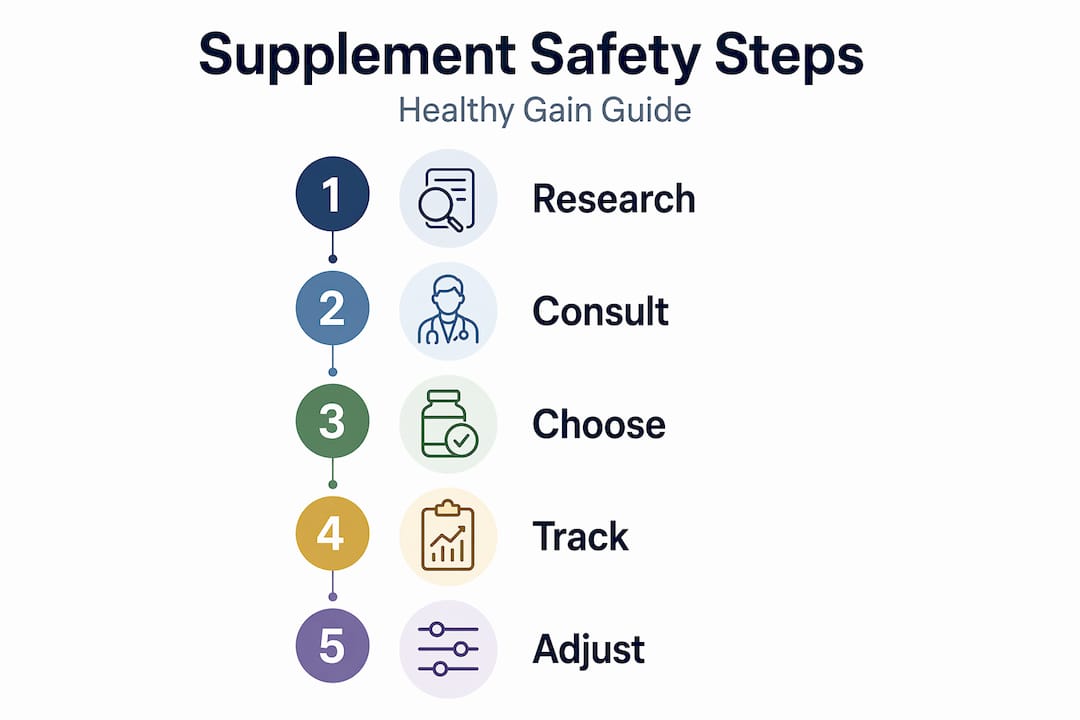
This is where everything becomes practical. Knowing the rules is one thing. Applying them in your daily routine is another. Follow these steps to build a supplement intake plan that actually works.
- Start with your deficiencies, not trends. What your blood work shows should guide your first choices. Adding a protein supplement or creatine on top of an iron deficiency you did not know about is counterproductive.
- Begin at recommended daily allowances (RDAs). Do not start at double the dose because you want faster results. The RDA exists for a reason, and your body needs time to adjust.
- Split mineral supplements throughout the day. This is a specific strategy most people do not know about. Only about 500 mg of calcium can be absorbed at one time, and minerals like iron and calcium actively compete for absorption when taken together.
- Never take iron and calcium at the same time. Separate them by at least two hours. The same applies to zinc and copper, which also compete.
- Review your supplement list with your provider every 90 days. Your needs change. What you needed in January may not be what your body needs in April.
- Monitor your body honestly. Keep a simple log. Track energy levels, appetite, sleep quality, and weight changes weekly.
“Vitamin D doses over 4,000 IUs per day can be toxic, and your doctor needs to know the exact amount you are taking to keep your intake in a safe range.”
Here is a quick reference for timing common supplements:
| Supplement | Best time to take | Avoid pairing with |
|---|---|---|
| Calcium | With meals, split doses | Iron, zinc |
| Iron | On an empty stomach or with vitamin C | Calcium, coffee |
| Vitamin D | With a fat-containing meal | N/A |
| Protein powder | Post-workout or between meals | N/A |
| Magnesium | Evening, with or without food | Large calcium doses |
For women specifically focused on gaining weight healthily, understanding why weight gain supplements work best alongside a calorie-sufficient diet makes the whole system click.
Following these steps ensures you incorporate supplements safely and effectively.
Common mistakes and troubleshooting when using supplements
Even women who research carefully fall into predictable traps. Knowing what they are in advance saves you time, money, and discomfort.
- Using supplements as a substitute for food. No supplement replaces the nutrient density, fiber, and metabolic signals that come from eating real meals. Supplements are additions, not alternatives.
- Chasing high doses for faster results. More is genuinely not better here. Toxicity from fat-soluble vitamins like A, D, E, and K builds up over time because your body stores them, not flushes them.
- Hiding your supplement use from your doctor. This is more common than it sounds. Many women do not mention supplements during appointments because they assume they are harmless. Weight-loss supplements alone often lack scientific evidence, can interact with medications, and cause real side effects. Your provider cannot protect you from interactions they do not know about.
- Buying based on influencer recommendations alone. Popularity is not evidence. A product trending on social media has not necessarily been tested in randomized trials.
- Ignoring early warning signs. Nausea shortly after starting a new supplement, jitteriness, disrupted sleep, or a sudden change in digestion are all signals worth paying attention to. Do not push through assuming your body just needs to “adjust.”
Pro Tip: When a new supplement causes any noticeable symptom, stop it for five days, then reintroduce it. If the symptom returns, that supplement is not right for your body at that dose or timing.
The women who get the best results from supplementation are the ones who treat their bodies as responsive and individual, not just as systems to override. Learn more about how body-focused supplements are designed with women’s specific physiology in mind.
Understanding these mistakes prepares you to verify your results safely.
Verifying supplement effectiveness and maintaining safe practices
Adding supplements is step one. Knowing whether they are actually working is step two, and most people never bother.
Here is how to evaluate what you are taking:
- Track changes weekly, not daily. Daily fluctuations in weight and energy are normal. Meaningful trends show up over four to eight weeks.
- Separate variables. If you change your diet, exercise routine, and start three new supplements at the same time, you will not know which change produced which result. Add one supplement at a time when possible.
- Seek out products backed by randomized controlled trials. Randomized trials are important to confirm supplement efficacy, because observational studies, which are far more common in supplement marketing, can mislead. An observational study showing that people who take a supplement are healthier does not prove the supplement caused the health benefit.
- Reassess every season. Your nutritional needs shift with your lifestyle, stress levels, and diet changes. A supplement you needed last winter may not be necessary now.
| Verification approach | What it tells you | Limitation |
|---|---|---|
| Weekly weight and measurements | Physical response over time | Does not isolate supplement effects |
| Blood tests before and after | Objective nutrient level changes | Requires lab visits and cost |
| Symptom and energy log | How you feel day to day | Subjective and influenced by many factors |
| Trial elimination (stop, then restart) | Whether a supplement is doing anything | Takes time and patience |
Building this kind of tracking into a broader natural wellness routine is the difference between guessing and actually knowing what your body responds to.
Rethinking supplements: a personalized, evidence-first approach for women
Here is something you will not hear often enough. Most supplement advice is written for an average person, and that person does not exist. Generic supplement guides overlook the fact that individual needs vary greatly in ways that matter: your metabolism, your gut microbiome, how your body absorbs fat-soluble vitamins, and even whether you drink coffee with your iron supplement all change your outcome.
Consumer culture around supplements has created a strange dynamic where more always feels like better, and not taking supplements feels irresponsible. Neither is true. A woman eating a varied, calorie-sufficient diet rich in protein and healthy fats may genuinely not need most of what she sees marketed to her. And that is okay.
What we believe in, based on what we have seen work for women who are serious about their body confidence goals, is this: supplements work best when they fill specific gaps, not when they replace nutritional effort. They work even better when paired with verified cosmetic supplement science that understands how women’s bodies actually respond to targeted ingredients.
The women who gain the most confidence from this process are not the ones who take the most supplements. They are the ones who take the right ones, know why they are taking them, and check in with a healthcare provider who knows their full picture. That is an evidence-first approach, and it is worth building your routine around.
Explore trusted supplements to support your healthy weight gain journey
You now have the knowledge to approach supplements the right way: with clear goals, verified products, and a healthcare provider in your corner. The next step is finding products that actually match that standard.
At Get Thick Products, we formulate our supplements and body enhancement products with women’s confidence and safety at the center, not as afterthoughts. Every product is designed to complement a food-first, lifestyle-focused approach to healthy weight gain and natural curve enhancement. Whether you are looking for dietary support or topical body care, you will find options built with real ingredient transparency. Browse our full range of trusted weight gain supplements and find the right fit for your goals, your body, and your wellness values.
Frequently asked questions
Are dietary supplements regulated for safety before being sold?
No, the FDA regulates supplements as food and does not review them for safety or effectiveness before they reach store shelves. Third-party testing seals are your best indicator of quality.
How can I avoid harmful interactions between supplements and medications?
Always tell your healthcare provider every supplement you take, including herbal and occasional-use products, so they can identify potential interactions. Supplements can interact with both prescription and over-the-counter medications in ways that are not always obvious.
What is a safe way to take minerals like calcium and iron?
Split mineral doses throughout the day and never take calcium and iron at the same time, since they compete for absorption. Separating them by at least two hours gives each a better chance to work.
Can taking high doses of vitamin D be harmful?
Yes. Doses over 4,000 IUs per day can reach toxic levels, particularly because vitamin D is fat-soluble and accumulates in the body. Always confirm your dose with your doctor.
Are weight loss supplements effective for healthy weight gain goals?
No, and they are worth avoiding. Weight-loss supplements lack evidence for effectiveness and may interfere with medications. For healthy weight gain, a food-first approach paired with targeted, verified supplements is the smarter path.
Recommended
- How to select supplements for confidence and natural curves – Get Thick Products
- 7 Surprising Benefits of Weight Gain for Women Naturally – Get Thick Products
- Body-focused supplements: benefits for women’s curves – Get Thick Products
- How supplements support women’s body shape and wellness – Get Thick Products